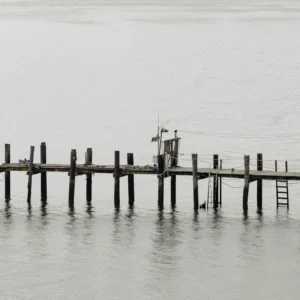
When a new dock replaces an old one in Green Cove Springs, the old dock is taken apart, hauled off and disposed of, and its pilings are either pulled out or cut off at the river bottom. How that goes depends on four things: the old dock’s condition, whether any part can be reused, where the new dock will sit, and how the treated wood is handled.
Demolition is a real part of the job and a real part of the price, so it is worth understanding before you compare bids. For the full new-build process, see our Green Cove Springs dock building page.
What Gets Removed and What Can Stay?
Usually the decking, framing, railings and hardware all go. Those parts wear out first and rarely match a new design. What sometimes stays is the part below the water.
- Decking and framing: almost always removed. Old boards are often split, warped or loose at the fasteners.
- Hardware and electrical: removed and replaced. Corroded bolts and old wiring are not worth carrying over.
- Pilings: evaluated one by one. Sound pilings in the right spot can occasionally be reused, but most replacement docks get new pilings because the new layout, loads or deck height do not line up with the old ones.
- Boat lift: sometimes reused if the lift is in good shape and the new dock is designed around it.
If the old dock is mostly sound and only a section has failed, a dock repair may make more sense than a full replacement. A builder should tell you that honestly at the site visit.
What Happens to Old Pilings?
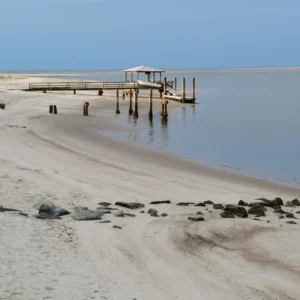
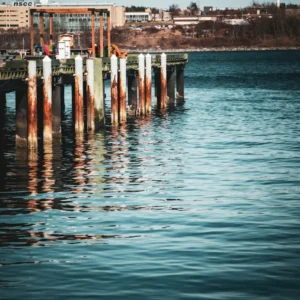
They are pulled out completely or cut off at the mudline. Pulling is cleaner, but long-embedded pilings in a firm bottom can be hard to extract and may snap. Cutting at the bottom leaves the buried section in place, which is out of the way of boats and propellers.
The choice depends on the piling’s condition, the new piling layout, and the bottom along the St. Johns River at your lot. Where the river bottom is soft near shore and firmer farther out, a crew may pull the inshore pilings and cut the deeper ones. Leaving old stubs sticking up above the bottom is not acceptable. They are a hazard to boats and swimmers.
Where Does the Old Wood Go?
Off your property, through proper disposal. Older docks were often built with chromated copper arsenate (CCA) treated lumber. The U.S. Environmental Protection Agency says not to burn CCA or other preservative-treated wood in a residential setting, and not to reuse CCA-treated wood in products such as mulch. EPA notes it can usually be disposed of through ordinary trash collection, though state and local governments may have their own guidance. A builder should haul it away, not leave it in a pile on your lawn.
Ask how disposal is handled and whether it is included in the price. Some low bids leave demolition and hauling out, then add them as a change order once the old dock is half gone.
Can the New Dock Go in the Same Spot?
Often, and it can simplify permitting. Florida law exempts replacing or repairing an existing dock from some state permits when the replacement is within 5 feet of the same location and no larger than the existing dock, according to section 403.813, Florida Statutes. The statute allows different construction materials and minor changes to meet current design standards.
If you want a bigger dock, a different shape or a new location on your shoreline, expect it to be treated as a new dock for permitting. Your builder confirms which path applies.
How Long Does Demolition Take?
For a typical residential dock, demolition is usually the short part of the project, often a matter of days rather than weeks. It can take longer when pilings resist pulling, when a lift or roof has to be dismantled carefully for reuse, or when access to the shoreline is tight.
On the St. Johns at Green Cove Springs, the shoreline slopes gently and docks often run a long way out to reach boatable water, so there can simply be more walkway and more pilings to remove than on a short canal dock. Factor that into the schedule.
Plan on being without a usable dock from the day demolition starts until the new one is finished. If you keep a boat at the dock, arrange somewhere else for it in the meantime.
Common Questions
Is demolition included in a new dock price?
It should be, but check. A complete bid lists removal of the old dock, piling extraction or cutting, hauling and disposal. If those lines are missing, ask before you sign, because adding them later is a common source of surprise costs.
Can I save money by reusing my old pilings?
Sometimes, if they are sound and line up with the new design. In most cases the new layout, deck height or lift needs different positions or heavier pilings. A builder can test each piling and tell you which, if any, are worth keeping.
Do I need a permit to remove an old dock?
Removal is usually handled as part of the replacement project’s approvals. If the new dock stays within 5 feet of the old one and is no larger, it may qualify for a state exemption. Local permits can still apply, so your builder checks before work starts.
Will demolition damage my seawall or yard?
It should not if planned well. Most work is done from the water, and pilings near a seawall are handled carefully to avoid cracking it. On a long Green Cove Springs dock, crews may also work from the walkway as they take it apart. Ask how they will access the site and protect landscaping.
Count Demolition in the Plan
A new dock starts with taking the old one out properly. Compare bids on what they include for removal, not just the new build.
We replace docks along the St. Johns River in Green Cove Springs and nearby Fleming Island. Contact us to have your old dock assessed and a replacement planned.