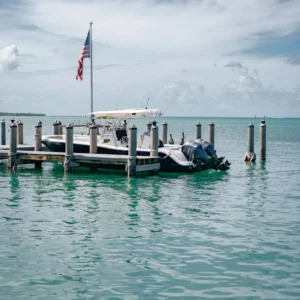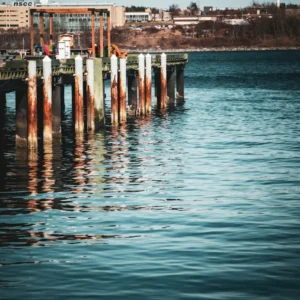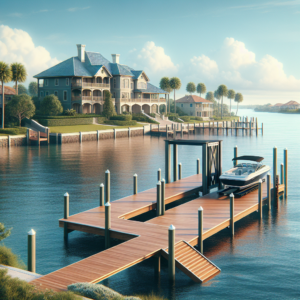
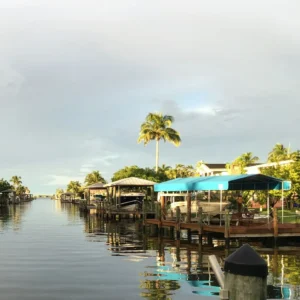
Yes. A new dock can be built off an existing seawall in St. Augustine, but it should stand on its own pilings rather than hang its weight on the wall. The answer for your lot turns on four things: the seawall’s condition and age, how the cap is built, the water depth in front of it, and your riparian setbacks.
This post walks through what a dock builder checks before tying a new dock to an existing wall, where the two structures should and should not touch, and when it makes more sense to fix the wall first. If you are early in planning, our St. Augustine dock building page covers how a project runs from site visit to final walkthrough.
Should a New Dock Rest on the Seawall?
No. The dock should carry its own load on its own pilings. A seawall is designed to hold back soil, not to take the downward and sideways forces of a loaded dock, a boat pushed into it by wake from the Intracoastal, or a lift full of a center console.
The usual approach is a short gangway or the first bent of the walkway set just waterward of the wall, with its own pilings, and a light connection at the cap that keeps the two structures aligned without transferring weight. That way, if the wall needs work later, the dock does not have to come apart with it.
What the Builder Looks at on the Wall
- Cap condition. Cracks, spalling concrete, or exposed rebar mean the cap cannot take even a light connection. Salt water on the Matanzas River and the San Sebastian River works on steel in concrete faster than fresh water does.
- Lean and bulging. A wall that has rotated toward the water is already losing the fight with the soil behind it.
- Sinkholes behind the wall. Soil disappearing from the yard side usually means joints or weep holes are letting fill wash out.
- Toe scour. Erosion at the base of the wall on the water side, which matters because new pilings will be driven close to it.
How Close Can New Pilings Go to an Old Seawall?
Close, but not right against it. Driving a piling next to an aging wall shakes the soil it is holding back, and a weak wall can crack or shift from the vibration alone.
As general guidance, builders often set the first row of pilings a few feet off the wall and check for tiebacks or anchors behind the wall before anything goes in the ground. Where a wall is fragile, some builders consider jetting instead of driving to reduce vibration. The right method depends on your soil and your wall, so ask your builder how they plan to install pilings near it. Hitting a tieback rod with a piling is an expensive way to find out where it was.
What Rules Shape a Dock Off a Seawall in St. Augustine?
The same state rules that apply to any private dock, plus a few local conditions that seawall lots in St. Augustine tend to run into.
- Size. Florida’s exemption for a single private dock outside Outstanding Florida Waters covers up to 1,000 square feet of over-water surface area, according to the Florida Department of Environmental Protection. Anything over that moves into a permit.
- Protected water. Stretches of the Tolomato and Matanzas rivers north and south of the city fall inside the Guana Tolomato Matanzas aquatic preserves, described in the DEP management plan. Aquatic preserves are Outstanding Florida Waters, so the exemption above may not apply there.
- Setbacks. For docks over state-owned submerged lands, Florida rule 18-21.004 requires structures to sit at least 25 feet inside your riparian rights lines, with exceptions such as single-family docks on shorelines under 65 feet. Canal lots on Anastasia Island, such as in Davis Shores, are often narrow, so this comes up a lot.
- Reach. Inside aquatic preserves such as the Guana Tolomato Matanzas preserves, Florida rule 18-20.004 limits a dock to 500 feet from the high water line or 20 percent of the waterbody’s width, whichever is less. Outside a preserve, the dock still has to stay clear of navigation, and in a tight canal that is often what decides the layout.
- Tide. Water in front of St. Augustine seawalls rises and falls with the ocean tide through the inlet. NOAA’s tide predictions for the Matanzas River at State Road 312 show the daily range in town, and a fixed dock has to work at both ends of it.
A builder will confirm which of these apply to your lot during the site visit. Nothing here replaces that check.
When Should the Seawall Be Fixed First?
When it has less life left than the dock you are about to build. A new dock can easily outlast a tired wall, and repairing the wall after the dock is in means working around and under the new structure, which costs more.
If the wall shows active failure, address it first through seawall and bulkhead repair, then build. If the wall is sound but aging, plan the dock so its pilings and connection points leave room for wall work later.
A Simple Way to Decide
- Wall sound, no lean, no soil loss: build the dock now and leave access for future wall maintenance.
- Minor cracking or joint gaps: repair those in the same mobilization as the dock, which saves a second equipment trip.
- Leaning, bulging, or losing fill: fix or replace the wall before the dock goes in.
Common Questions
Can I bolt a new dock directly to my seawall cap?
It is not recommended. A seawall cap is not designed to carry dock loads, and bolting into it can crack the concrete and open a path for salt water to reach the steel inside. A light alignment connection is fine, but the dock’s weight should sit on its own pilings set just off the wall.
Will building a dock damage my existing seawall?
It can if pilings are driven carelessly near a weak wall. Vibration, hitting a tieback, or scouring the toe are the usual causes. A builder who inspects the wall first, locates tiebacks, and adjusts piling placement and installation method keeps that risk low, even on older St. Augustine walls.
Do I need a permit to build a dock off my seawall?
It depends on the size and the water. A private dock under 1,000 square feet outside Outstanding Florida Waters may qualify for a state exemption, but you still need to meet setback and location rules, and St. Johns County or city building permits may apply. Your builder confirms this for your address.
Should I replace my seawall and build a dock at the same time?
If the wall needs replacing anyway, yes. Doing both in one project avoids working around a brand new dock later, uses one barge and equipment mobilization instead of two, and lets the dock connection be designed with the new wall from the start, so the pilings and cap line up cleanly.
Start With the Wall
On a seawall lot, the wall is the first thing a builder looks at, because it decides where the dock can start and how long the whole waterfront will last. Get that read before anyone draws the dock.
We design and build new docks in St. Augustine and nearby St. Augustine Beach. Contact us to set up a site visit and we will look at your seawall and shoreline before we talk about the dock.