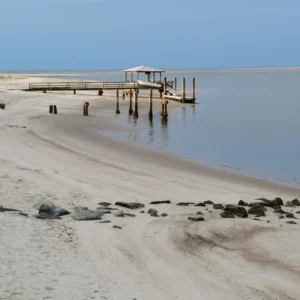
The best dock design for a Julington Creek waterfront lot is usually a straight walkway out to measured low-water depth with an L-shaped head, set at a height that works across the tide and placed clear of heavy tree cover. Three things decide the details on your lot: depth at low tide, the tidal swing, and the canopy overhead.
Design around those three things and the dock works. Ignore them and you get a structure that is unusable at low tide, sits too low in the water, or spends its life under falling debris. A design that works two miles away can be wrong on your lot. Our Julington Creek dock building page covers how a project runs from site visit to final walkthrough.
Start With Depth at Low Tide, Not High
This is the mistake that costs the most to correct. People look at the water on a nice afternoon, see plenty of depth, and design to it. Then they discover that for several hours a day their boat is sitting on the bottom.
The number that matters is usable depth at mean low water, measured where the boat will actually sit. Not at the shoreline, not at the end of the neighbor’s dock.
What follows from it:
- How far out the structure has to go. On the shallower stretches of the creek this can mean a walkway considerably longer than the dock head itself.
- Whether a lift makes sense at all, or whether a floating option suits the depth better.
- What draft you can realistically keep there. Better to know before buying the boat than after.
Design for the Tidal Range
Julington Creek connects to the St. Johns and it moves. A dock set at a comfortable height for high tide can be an awkward climb at low tide, and a dock set for low tide can be close to awash at the top of the range.
Practical answers:
- Set deck height off the observed range at your specific spot, not a general figure for the area
- Use a stepped design where a higher landing steps down to a lower platform, so there is a comfortable working height across most of the tide
- Put in a proper ladder rated for the full range, not a short swim ladder that hangs above the water at low tide
- Consider a floating section off a fixed walkway, which self-adjusts and makes boarding consistent
Plan Around the Trees
Tree cover is the trade-off on this creek. It is the reason the lots are attractive and it is hard on a dock.
Overhanging oaks mean constant leaf litter and organic debris, which holds moisture on a wood deck and accelerates the exact decay you are trying to avoid. It also feeds algae growth, which is what makes a dock slippery.
Design responses that actually help:
- Position the dock head clear of the heaviest canopy where the lot allows it
- Favor composite or a well maintained sealed wood surface, since untreated wood under constant leaf litter has a short life here
- Use wider board gaps so debris falls through rather than sitting on the deck
- Budget for a regular clean and seal cycle rather than treating it as optional
Layout Choices That Suit the Creek
Straight Walkway With an L Head
The most common and usually the most sensible on a creek lot. The walkway gets you to depth, the L gives you a working platform and somewhere to tie up alongside.
T Head
More platform area for the same reach, and better if you want space for seating or fishing as well as mooring. It costs more framing than an L.
Fixed Walkway With Floating Platform
Strong option where tidal swing is the dominant problem. Consistent boarding height regardless of tide, at the cost of more moving parts and more maintenance.
Covered Dock
Shade and protection from the tree debris, though it adds height, cost and permitting complexity. Worth raising early if you want it, because it changes the structure from the pilings up.
Do Not Skip the Riparian Line Question
Creek lots are narrower than open water lots and riparian lines converge. On a curved shoreline, a dock extending straight out from your bank can end up crossing a neighbor’s line. Establishing this before design rather than after is far cheaper.
Questions From Julington Creek Owners
Can a boat lift work in shallow water?
Sometimes, with the right lift style and enough water under the cradle at low tide. Where depth is marginal on the shallower stretches of the creek, a floating platform or a longer walkway to deeper water may serve better. A builder should sound the depth where the lift would sit before you commit to one.
How long does a creek dock need to be?
As long as it takes to reach usable depth for your boat at low tide, and that varies a lot along Julington Creek. Some lots reach good water quickly, while others need a long walkway across shallow flats. The length is measured on site with soundings, not estimated from the shoreline.
Does tree cover mean composite is the only option?
No. Wood works well under trees if it is cleaned and sealed on a regular schedule. It is the neglected wood deck under heavy canopy that fails early, because wet leaf litter holds moisture against the boards. Composite cuts that upkeep, but it still needs regular cleaning to stay safe underfoot.
Getting the Design Right First
Design is the cheapest phase to change and the most expensive phase to get wrong. Depth, tide range and canopy on your specific lot should drive it.
We build docks in Julington Creek and nearby Mandarin. Our dock builder service covers design, permitting and construction together. Contact us to measure your depth and plan the layout.