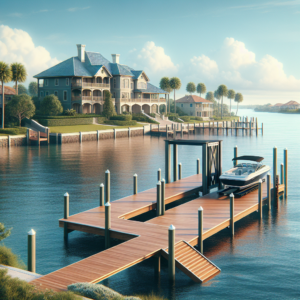
A St. Augustine dock that holds up to hurricanes is generally built with deeper, heavier pilings, through-bolted connections, corrosion-resistant hardware, and a deck set high enough to clear normal surge. No dock is storm-proof, but these four choices decide whether a storm costs you a few boards or the whole structure. All of them are cheapest to get right during the build.
This post covers what storm-ready design looks like on the Matanzas River and the San Sebastian, what tends to fail first, and how to plan the build around the season. For the full build process, see our St. Augustine dock building page.
What Usually Fails on a Dock in a Hurricane?
The connections, more often than the wood. When surge lifts water under a deck, it pushes up on every board and every joist. Docks that were nailed together or hung on light hardware come apart at those joints, and the pieces become debris that damages the next dock down the shore.
The other common failures are pilings that were too short to resist being pushed over, and boat lifts that were left loaded or set too low. Our post on how storm surge affects seawalls in St. Augustine covers the same forces from the shoreline side.
Which Design Choices Matter Most?
Pilings
Deeper embedment and larger diameter at the outer end, where wave load is highest. Pilings that reach firm soil resist the sideways push of water far better than ones that stop in soft sediment.
Connections
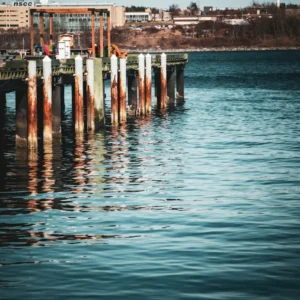
As general guidance, many coastal builders use through-bolts with washers at the stringer-to-piling joints and structural screws or ring-shank fasteners for decking, with hot-dip galvanized or stainless steel hardware to slow corrosion in salt air. The exact hardware should come from your builder’s design and the product ratings, so ask them to specify it in writing. A rusted bolt is a weak bolt.
Deck Height
A higher deck sits above more of the surge and waves. The trade-off is a bigger step down to the boat at low tide, which is usually solved with a lower landing or a ladder rather than dropping the whole dock.
Deck Board Gaps
Gaps between boards let water pass through instead of lifting the deck as a single sheet. Some owners go further and build sections that can be removed before a storm. We cover that option in a separate post for Jacksonville owners.
How Should a Boat Lift Be Built for Storms?
Mounted on its own heavy pilings, rated for more than the boat it holds, and set so the cradle can be raised well above typical surge. The lift should also have a clear plan for the boat. In most storms, the safest place for the boat is not on the dock at all.
If you already have a lift and want it checked before next season, our storm readiness planning service walks the whole dock and lift with you.
When Is the Best Time to Build in St. Augustine?
Outside hurricane season if you can. The Atlantic season runs from June 1 to November 30, according to the National Hurricane Center. Starting a build in late fall or winter means the dock is finished and the new wood has had time to settle before the next season begins.
Permitting can take time, so planning in late summer or fall and building over the winter is a practical pattern for many St. Augustine homeowners.
What Should You Ask a Builder About Storm Design?
Ask for specifics, in writing. A builder who has thought about storms will answer these without hesitation:
- How deep will the outer pilings go, and how will you confirm it on site?
- What hardware grade are you using at the stringer and piling connections?
- What deck height are you planning, and what water level is it based on?
- How is the lift mounted, and how high can the cradle go?
- Which parts of the dock would you expect to repair first after a strong storm?
The last question is telling. Every dock has a weakest point, and a good builder knows where it is and has made it the cheapest thing to fix.
Common Questions
Can a dock be made hurricane-proof?
No. A strong enough storm can damage any structure on the water. What good design does is reduce how much breaks and keep the dock from coming apart into debris. Heavier pilings, bolted connections and higher decks make the difference between a repair and a rebuild.
Is composite decking better for storms than wood?
Not by itself. Decking is rarely what fails first in a St. Augustine storm. The pilings, framing and connections hold the dock together, and composite boards still need proper fasteners and spacing to stay put. Choose decking for maintenance and feel, and choose the structure for storms.
What hardware should a coastal dock use?
As general guidance, many coastal builders use hot-dip galvanized or stainless steel bolts, nuts and washers, sized for each connection, because plain steel corrodes quickly in salt air near the inlet and along the Matanzas. The right choice depends on the design and the hardware maker’s ratings, so ask your builder to specify it in writing.
Should my new dock be built higher than my neighbor’s?
Not necessarily higher than theirs, but high enough for your water and tide. Your builder sets deck height from the site’s high water levels, boat type and access needs. Matching an older dock next door is not a good reason to go lower.
Build It Once, Built for the Water
Storm resistance is mostly decided in the design. Ask every builder what pilings, hardware and deck height they plan, and why.
We build new docks across St. Augustine, Vilano Beach and St. Augustine Beach. Contact us to talk through a storm-ready design for your lot.