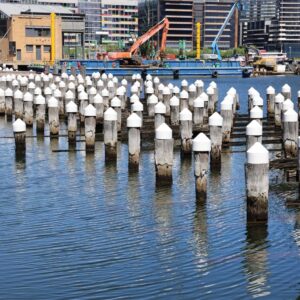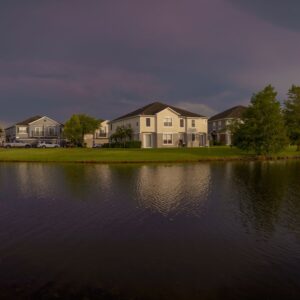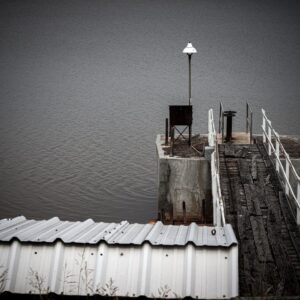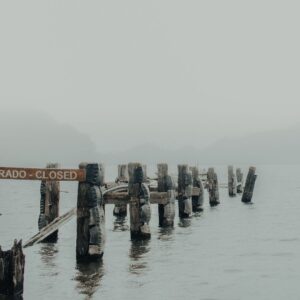
Almost every dock we end up rebuilding was described to us the same way: it felt fine right up until it didn’t. That is not bad luck. It is the normal failure pattern for a structure where the working parts sit underwater and nobody looks at them.
The deck surface is the last thing to go. By the time you feel movement up top, the problem below has usually been running for a couple of years.
Marine Borers Working From the Inside Out
In brackish and salt water along the St. Johns and the Intracoastal, marine borers are the single biggest threat to untreated or aging wood pilings. Shipworms and gribbles do not eat the outside of a piling. They tunnel in through small entry holes and hollow it out.
The result is a piling that looks completely normal at the waterline and is close to empty a foot below it. When it fails, it fails suddenly, because there was never any visible warning.
What Borer Damage Looks Like
- A pinched or hourglass shape in the piling just below the low tide line
- Small round entry holes, often no bigger than a pencil tip
- Soft wood that gives when you press a screwdriver into it below the waterline
- Sawdust-fine debris in the water around the base
Scour Around the Base
Water moving past a piling speeds up as it goes around it. Over years, that accelerated flow pulls bottom material away from the base. The piling is still the same length, but less of it is in the ground.
Scour is worse where current is strongest, so the outer pilings and the ones nearest a channel tend to go first. It is also the reason a dock can develop a slow lean toward the water without any single event causing it.
You can usually spot it at low tide. If one piling sits in a visible depression while its neighbors sit flush with the bottom, that is scour.
Corrosion on Hardware and Fasteners
Brackets, through-bolts and lag screws below the splash zone corrode faster than anything above it. Salt water plus constant wetting plus dissimilar metals is about the worst environment you can put steel in.
Galvanic corrosion is the one that surprises people. Put stainless hardware against galvanized hardware in salt water and one of them starts sacrificing itself. The bolt head can look perfect while the shank inside the wood has lost most of its diameter.
Concrete and Composite Are Not Immune
Concrete pilings crack and spall as the rebar inside them corrodes and expands. On composite and vinyl-sleeved pilings, the failure point is usually where the sleeve was cut or damaged, because that is where water gets behind it and works on whatever is underneath.
How to Check Without Getting in the Water
You can learn a lot from the dock itself at the lowest tide of the month.
- Sight down the line of pilings. They should form a straight row and all lean the same direction, which is usually none. Any piling out of line is telling you something.
- Push test at chest height. Firm pressure against each piling. You are feeling for give, or for a knock that the others do not have.
- Probe the wood at the low tide line. A screwdriver or awl should not sink in more than a quarter inch on sound treated wood.
- Look at the water line itself. Compare the width of each piling right at the water to the width a foot above it. Any narrowing is a red flag.
- Check the bottom around each base. On a clear low tide you can often see whether the bottom is flush or dished out.
What this will not tell you is what the piling looks like three feet down. That takes an in-water inspection, which is what our dock inspection service covers.
Frequently Asked
How deep does the damage usually start?
Borer activity concentrates in the zone that stays submerged, so typically from just below the low tide line downward. Corrosion is worst in the splash zone where hardware gets wet and dries repeatedly.
Can a hollowed piling be saved?
Sometimes. Sleeving or jacketing a piling that still has sound core can extend it significantly. If the section is gone, it needs replacing. That call comes down to how much sound material is left, which is why probing matters more than looking.
How often should this be checked?
Once a year is reasonable for most residential docks in Northeast Florida, and after any named storm regardless of when the last check was.
Catch It While It Is Still a Repair
The difference between a piling repair and a dock rebuild is usually about eighteen months of not looking. If you have not had eyes below the waterline in a year or more, that is the place to start.
Our team handles piling repair and full dock repair throughout Northeast Florida. Check the service areas list to see if we cover your stretch of water.