
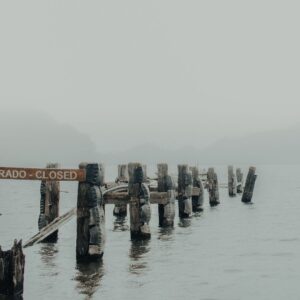

If your Fleming Island dock rocks when you walk across it, or pilings look leaned since the last storm season, the water beneath is likely doing unseen damage. Doctor’s Lake’s brackish tidal water and constant boat wake stress corrode fasteners and expose pilings to salt-air damage that compounds year after year. The waterfront neighborhoods around Fleming Island Plantation and deeper waters along the St. Johns River both face this same brackish tidal pressure. Your dock may feel solid above the waterline, but wood decay and piling wash-around happen in clay sediments below. Early dock repair in Fleming Island stops structural creep that turns minor settling into permanent frame shifts.
A leaning piling often signals wash-around below the mud line, which pulls the decking out of level over time. That’s where piling repair comes in, paired with dock leveling to reset the deck surface. On Doctor’s Lake, where brackish tidal water and boat wake stress keep fasteners corroding, you may also notice soft boards underfoot, signaling moisture damage that requires a cleaning and sealing service. Bulkhead undermining is less common on Fleming Island’s residential docks, but properties with boat lifts near the St. Johns River often need boat lift repair when cables stretch or motors fail from salt exposure in the brackish tidal environment.
We work with residential waterfront homeowners across Fleming Island, from established neighborhoods around Fleming Island Plantation to newer builds along Doctor’s Lake where dock enhancement is common. We’re familiar with Clay County waterfront permitting and the specific marine-grade materials needed for brackish tidal water with salt-air corrosion and boat wake stress. Our diagnostic approach means we assess pilings below the mud line, check frame integrity, and evaluate decking scope before quoting, rather than guessing at scope. Seasonal hurricane damage assessments are routine for us after Northeast Florida’s storm seasons, and we prioritize properties where permanent frame shifts pose risk to the whole structure.
Request a free assessment of your Fleming Island dock before storm season. We’ll examine pilings below the mud line, test decking for moisture damage, and evaluate settling patterns across Fleming Island Plantation and other established waterfront neighborhoods. You’ll know exactly what’s wrong and what repairs are actually needed without high-pressure estimates. We assess first, quote clearly, and let you decide what makes sense for your property.
A leaning piling is the most obvious sign, but dock problems often hide below the water line. Soft or spongy decking underfoot means moisture has reached the fasteners below, and uneven deck boards indicate piling settlement in clay sediment. On Doctor’s Lake, where brackish tidal water and boat wake stress keep pressure on pilings, you may also notice the dock tilting slightly away from shore or an increase in gaps between boards during low tide. Any combination of these symptoms warrants a full underwater assessment.
Several factors influence the scope of dock repair work. The damage type matters most: piling rot is simpler than a sinking frame, and fastener replacement costs less than full decking replacement. Dock size obviously plays a role, and material choices depend on your waterfront location. On Doctor’s Lake, we use marine-grade materials rated for brackish tidal water, salt-air corrosion, and boat wake stress. The severity of settlement or the number of pilings needing work also shifts the assessment. We can’t quote without seeing the dock, which is why we start with a thorough evaluation.
The ideal time to repair your Fleming Island dock is in late spring, before the Northeast Florida hurricane season begins in June. Spring repairs give you a solid, safe dock through the summer boating season and the storm months ahead. If your dock sustains damage during or after hurricane season, post-storm repairs are urgent because water intrusion and structural loosening get worse with each tide cycle. We also recommend a pre-season inspection in May to catch any settling or corrosion that winter weather may have worsened. Waiting until fall or winter delays repairs until docks are most stressed by storms.
Repair makes sense when pilings are sound below the mud line, the frame is intact, and damage is limited to fasteners or decking. If you have significant piling rot or a frame twisted by settlement, replacement may be necessary. Our assessment checks piling integrity underwater, evaluates whether main beams support your needs, and determines if decking repair restores stability. Most Fleming Island docks need repair, not replacement, because residential structures hold up well if pilings haven’t failed. We’ll tell you honestly whether your dock is salvageable or if a new build is the safer choice.

Your Fleming Island dock doesn’t need a guessing game, it needs a clear picture. Bring a photo, describe what you’re seeing, and we’ll tell you what our assessment will likely find. If it’s piling settlement, moisture-damaged framing, or salt-air erosion eating away at fasteners on Doctor’s Lake, we’ll catch it during the walk-around. Contact us to schedule your free dock evaluation and get a repair plan that addresses what your waterfront property actually needs.